
You go to a routine appointment. Your provider feels your belly or pulls up a quick ultrasound and says, “Baby’s head is up.” Maybe they just flat out told you your baby is breech. Maybe they followed it with, “Let’s see what happens at your next visit.” Either way, you probably walked out with more questions than answers, and Google didn’t help much. (Let’s maybe step away from Google, anyway, especially if you find yourself consumed or scared.)
Dear one, let’s hold hands and walk through what comes next together. (In a comforting way, not a “let me hold your hand when I say this” type of way.)

What is a breech baby?
A breech baby is positioned head up, with their bottom, feet, or both pointing down toward the cervix. Providers may use terms like frank breech (bottom down, legs straight up toward the face), complete breech (sitting cross-legged), or footling breech (one or both feet down- and if you ever see me in person, definitely ask me about the footling breech vaginal birth I once attended.)
If you’re early in your pregnancy, your baby being in that breech position is super common. About a quarter of babies are breech before 28 weeks. By 32 weeks, that number drops to around 7%. By full term, only 3 to 4% of babies are still breech. If you’re 30 weeks and just heard the word “breech,” your baby still usually has plenty of time and room to move.
How to help a breech baby turn
Many families try positioning work while there’s still room for your baby to turn. A few options:
- Spinning Babies. Their Daily Essentials and breech-specific techniques are a common starting point. Your doula team can walk you through them. (Their site has a lot on it, but there’s a section specifically about flipping a breech baby.)
- Webster-certified chiropractic care. The Webster technique focuses on pelvic balance. (We have a local Webster-certified chiropractor listed on our Resources page.)
- Acupuncture or moxibustion. Some families explore these. Talk with your provider first. (If you’re interested in what that looks like, we have an older post here.)
None of these come with a guarantee. Sometimes a baby is breech for a reason, like cord length, placenta location, amniotic fluid levels, or the shape of your uterus. Positioning work can help, but if the baby stays breech, it doesn’t mean you did something wrong.
What are my options closer to term?
If your baby is still breech around 36 weeks, your provider will likely discuss next steps with you. Your options usually include:
- Waiting. Some babies turn late, even close to or during labor.
- External cephalic version (ECV). A procedure to turn the baby head down (more on this below).
- Planned cesarean. This is the most common route for breech babies in the U.S.
- Vaginal breech birth. This requires a provider trained and experienced in breech birth, and it isn’t widely available. If you’re interested, ask your provider directly. (If you are planning a homebirth, your options will also include collaborative care since a midwife cannot attend a planned vaginal breech home birth in AL.)

What is an ECV?
An ECV is when your provider places their hands on the outside of your belly and works to turn the baby into a head-down position. It’s usually done around 37 weeks, in the hospital.
Here’s what typically happens:
- The doctor confirms your baby’s position by ultrasound and monitors your baby’s heart rate before the procedure.
- You may have an IV placed and bloodwork drawn.
- You may be given medication to relax your uterus, which can make turning easier.
- Your provider presses and guides the baby into position, often using ultrasound during the procedure.
- Baby is monitored again afterward.
ECVs work about half the time. They can be uncomfortable, and you can ask your provider to pause or adjust at any point. There is a small risk that baby will need to be born right away by cesarean (roughly 1 in 200), which is why ECVs are done where a cesarean can happen quickly.
Questions to ask before your ECV
Bring these to your appointment. You don’t need to ask all of them, but they’re a good place to start.
- How many ECVs do you do, and what is your success rate?
- Is there anything about my pregnancy that makes ECV a poor fit? (Placenta location, fluid levels, a previous cesarean)
- Where will it happen, and how long should I plan to be there?
- Do I need to stop eating or drinking beforehand?
- Will I get medication to relax my uterus?
- Is an epidural or spinal an option during the ECV?
- How long will baby be monitored afterward, and what are you watching for?
- If it doesn’t work, can we try again? When?
- If it works, what are the chances baby turns back? What happens then?
- If baby stays breech, when would a cesarean be scheduled? Would you wait for labor to start on its own?
- Do you offer vaginal breech birth, or can you refer me to someone who does?
Plan for both outcomes
Even if you’re hopeful the ECV will work, it helps to prepare for a cesarean too. Planning ahead makes the decisions easier if you need them.
- Pack your bag with a cesarean in mind. Our Packing for Your Cesarean post covers what we’d add.
- Write a cesarean birth plan. We talk about this in How to Write a Birth Plan.
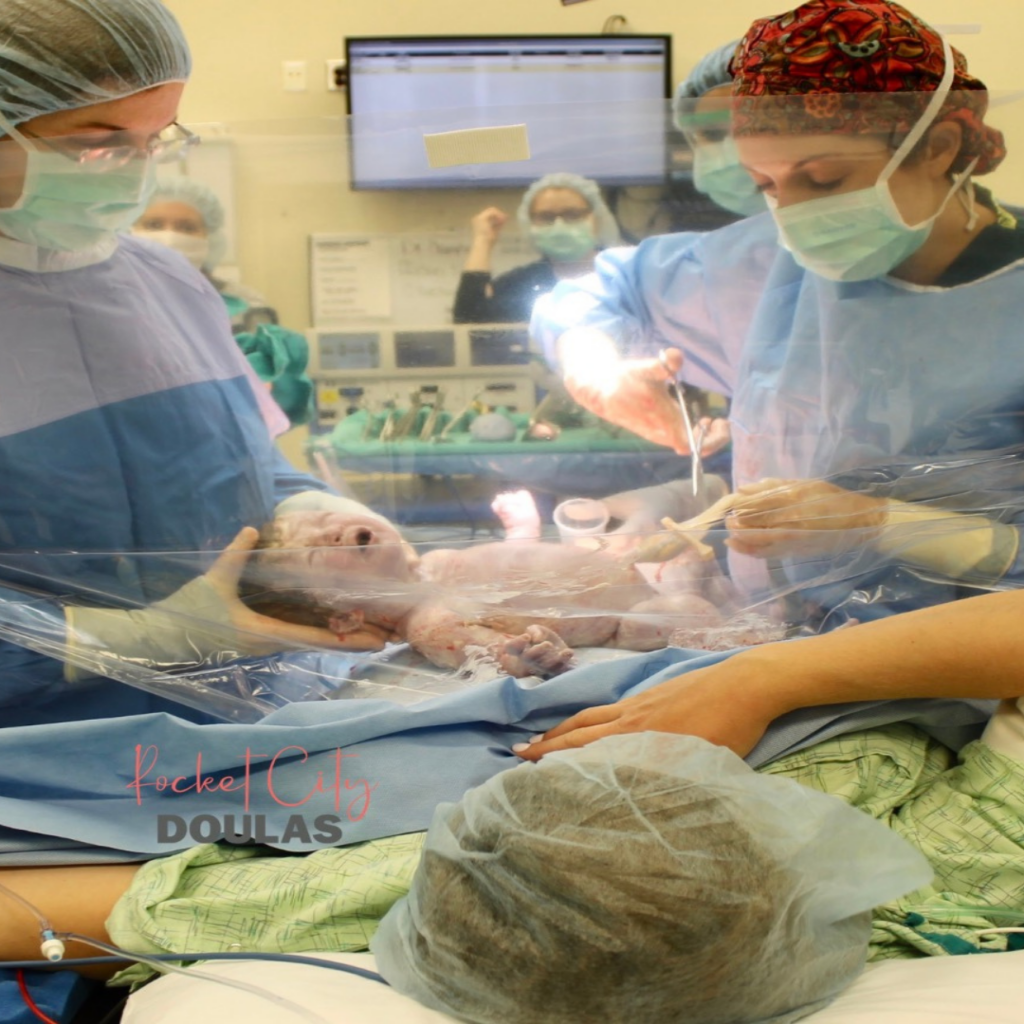
- Ask your provider about family-centered cesarean options, like a clear drape, skin-to-skin in the operating room, and delayed cord clamping. (You may have seen our clear drape photo below making its way around the internet.)
How your doula team can help with a breech baby
Let your doulas know as soon as your provider mentions breech, even if it’s early and just a “we’ll check again next time.” (This is one of the times on our When to Call Your Doula list.) Your doula team can:
- Send you positioning resources and walk you through them.
- Help you prepare questions before your next appointment, not after.
- Talk through your options with you using the BRAIN method (Benefits, Risks, Alternatives, Intuition, Nothing)
- Check in with you after your ECV
- Support you through a scheduled cesarean, including your birth plan and what to expect on the day.
Breech can feel like it changes everything. Most of the time, it just changes the route. You still get to make informed decisions about how you get there, and your Rocket City Doulas team is here to help you do just that.